The Oil and Gas Addendum
Retained-Acreage Clauses and Horizontal Wells: Texas Court of Appeals Issues Mixed Ruling for Landowners
Let’s assume you signed a new oil and gas lease with ABC Production in March 2018 (the “2018 Lease”). Given the size of your farm (i.e. 1000 acres), you successfully negotiated a “retained acreage” clause in the 2018 Lease. The clause provides that, at the end of the five (5) year primary term, the leasehold shall expire as to all acreage except a rectangular 160 acre block around each producing horizontal well. The clause further stipulates that if the wellbore extends more than five thousand (5,000) feet in the “producing formation”, the lease shall remain in effect as to a 480 acre rectangle around each producing well.
In February 2023, ABC Production forms the Stockton Unit. Your one thousand (1,000) acre farm is the sole leasehold in the Unit. Shortly thereafter, two horizontal shale wells are drilled in the Stockon Unit. Well records filed with the Pennsylvania Department of Environmental Protection (“PaDEP”) depict that the wellbores were drilled into the Marcellus Shale but are relatively short, having only a total length of approximately nine thousand (9000 feet). The Marcellus Shale underlying your farm is found at an average depth of 4,850 feet. As per the retained-acreage clause, you assume that the 2018 Lease should now automatically expire and terminate as to all acreage outside of the “retained” acreage (i.e. a rectangle of 160 acres around each horizontal well). This assumption is based on your understanding that only four thousand four hundred (4,400) feet of each wellbore actually runs horizontally through the Marcellus Shale – the balance of the wellbores’ length are either vertical and/or outside the producing shale formation.
One of ABC Production’s competitors, Big Shale, offers you a new lease on the non-developed acreage (i.e. 680 acres). The new lease terms are very competitive. But before you sign the new lease with Big Shale, the landman for ABC Production visits the farm and informs you that the 2018 Lease remains in effect as to 960 acres, not just 320. He explains that because the wellbores each exceed five thousand (5,000) feet, the larger acreage calculation was triggered. As such, only forty (40) acres are available for the Big Shale new lease. You are shocked, frustrated and confused. How is the horizontal portion of a wellbore actually measured?[1] Does the entire length count? A recent decision by the Eighth District Court of Appeals (El Paso) in Texas addressed this novel question. As described below, the courts’ opinion may have introduced more confusion and ambiguity into an already grey area of oil and gas law.
Before we address the substance of the court’s opinion in MRC Permian Co. v. Point Energy Partners Permian, LLC (Texas App. - El Paso, December 9, 2025), a brief primer on the distinction between a “retained-acreage” clause and a Pugh clause may be helpful. Both clauses are frequently requested by landowners in modern oil and gas leases.
Under a traditional oil and gas lease, production anywhere on or under the leased premises will maintain and hold the entirety of the leasehold. See, Pooling Clause Not Necessary: West Virginia Court Finds Implied Right to Pool Exists Where Lease Silent (May 2016). This is true even if only a small fraction of the leasehold is actually producing the - entire lease may be held by a single producing well. See, Matthews v. Sun Oil Co., 425 S.W. 2d 330 (Tex. 1968). A corollary to this principle is that the entire leasehold will be maintained by production occurring anywhere within in a production unit which the lease has been pooled. See, Hordis v. Cabot Oil and Gas Corporation: Landowner Challenges Whether Driller Can Ignore Pooling Clause and Simply Rely on Act 85 (July 2020). So, if only ten (10) acres out of a five hundred (500) acre lease are pooled into a production unit, such unit production will nonetheless hold the entire five hundred (500) acre leasehold. The retained-acreage clause and the Pugh Clause were developed to mitigate these types of harm and protect the lessor from the economic consequences of undeveloped or non-producing acreage. But the clauses operate in different ways.
The Pugh clause operates to sever or release non-pooled acreage at the end of the primary term. See, Fed. Land Bank of Spokane v. Texaco, 820 P.2d 1269, 1272 (Mon. 1991) (“. . . the Pugh clause does just what it provides; it terminates the lease as to the lands not embraced in a producing oil and gas unit”); Egeland v. Continental Resources, 616 N.W. 2d 861, 866 (N.D. 2000) (observing that “the Pugh clause is to protect the lessor from the anomaly of having the entire property held under a lease by production from a very small portion of it”). So, the Pugh clause limits the effect of pooling by requiring the surrender of non-pooled acreage and formations.
Conversely, a retained-acreage clause operates regardless if a leasehold has been pooled or not. As such, a typical “retained acreage” will designate what acreage is to be “retained” around each producing wellbore. See, Humphrey v. Seale, 716 S.W. 2d 620 (Tex. App. - Corpus Christie, 1986) (retained-acreage clause stated that the lessee would retain “forty (40) acres designated as a well block around each producing well”); See also, PPC Acquisition v. Delaware Basin Resources, 619 S.W. 3d 338 (Tex. App. - El Paso, 2021) (“[A] retained-acreage clause functions as a snapshot provision when it can only be triggered once, such as at the end of the primary term . . . requiring lessee to release the designated amount of unretained acreage at that time”). Acreage that falls outside of the designated drainage zone of each wellbore must be released and surrendered. As I have written before, both clauses are particularly valuable to landowners with significant oil and gas acreage. See, Not Your Father’s Oil and Gas Lease (March 15, 2022).
Returning to the MRC Permain case, at issue were four (4) identical leases executed in 2014 concerning approximately four thousand (4,000) acres in Loving County, Texas (the “Subject Leases”). The Subject Leases contained a retained-acreage clause which was triggered at the end of the three (3) year primary term. The clause mandated the release and surrender of all acreage located outside certain designated production zones. For horizontal wells, the rectangular zone around each wellbore was 176 acres. However, if the wellbore extended more than five thousand (5,000) feet horizontally “in the producing formation”, the rectangular zone was expanded to 352 acres. Prior to the expiration of the primary term in May 2017, the lessee, MRC Permian Company (“MRC”), drilled two (2) horizontal wells. MRC argued that the horizontal length of each wellbore exceeded five thousand (5,000) feet. As such, MRC asserted that the Subject Leases remained in effect as to 704 acres (352 x 2 = 704). The landowner and its new lessee, Point Energy Partners Permian LLC (“Point Energy”), disputed this calculation and contended that the actual horizontal length of each wellbore was less than five thousand (5,000) feet. Given this alternative measurement, Point Energy argued that the retained acreage was only three hundred twenty (320) acres (160 x 2 = 320).
MRC filed suit in June 2017 seeking a declaration that the Subject Leases remained in effect as to at least 704 acres.[2] Point Energy filed a counterclaim asserting that MRC was entitled to only retain 160 acres around each well. The trial court agreed with Point Energy that the Subject Leases expired in May 2017 but rejected Point Energy’s calculation of the wellbore length. After a lengthy appeal to the Texas Supreme Court on an unrelated issue, the retained acreage question was remanded back to the Court of Appeals.
This dispositive issue before the Court of Appeals was relatively straightforward: when is a horizontal wellbore considered horizontal? Answering this question was not quite as simple. Because the Subject Leases were silent on this issue, the Court of Appeals was required to weigh two complex yet competing methods of wellbore measurement.
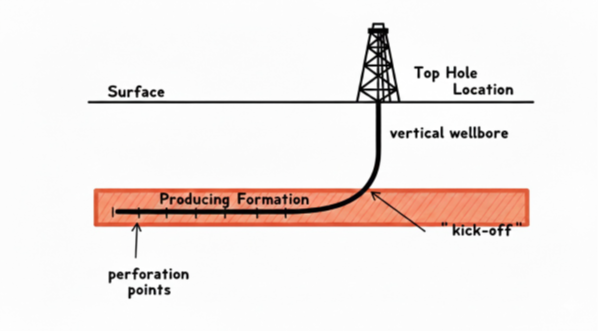
Point Energy argued that the measurement should only count producing segments of the wellbore that are at near horizontal orientations. Under Point Energy’s methodology, the horizontal measurement begins at the first “take point” or perforation.[3] This calculation essentially excludes non-producing segments of the wellbore (i.e. the vertical portion of the wellbore as well as the curved “kick-off” segment). In support of this “take point” approach, Point Energy relied on recent Texas Supreme Court caselaw which recognized a distinction between the producing and non-producing segments of a horizontal wellbore. See, Murphy Exploration & Production v. Adams, 560 S.W. 3d 105 (Tex. 2018) (“the vertical portion of a horizontal wellbore and the nonperforated portions of the horizontal wellbore are essentially irrelevant for production purposes”).See also, Murphy Exploration v. Adams: Texas Supreme Court Suggests that Horizontal Wellbore Will Not Drain Hydrocarbons From Adjacent Tract (February 2019). Point Energy further argued that a wellbore cannot be considered “horizontal” until it is roughly at a 90-degree angle from vertical to horizontal. Like other horizontal wells, the wellbores at issue in MRC Permain started vertically and then gradually curved into the designated horizontal plane. This bend or curve is known as the “kick-off” point.[4] Point Energy argued that this curved segment, which is almost never perforated, should not be counted even if a small portion of it is within the producing shale formation. The following diagram illustrates the key aspects of Point Energy’s position:
MRC argued the Point Energy’s approach was unsupported by the plain language of the Subject Leases and inconsistent with contemporary drilling practices. First, MRC argued that the Subject Leases only specified that the wellbore itself had to extend five thousand (5,000) feet “in the producing formation.” It did not limit or restrict the measurement to “producing” segments. Nor did the Subject Leases make any reference to perforation points or take-points. MRC essentially argued that the Subject Leases merely required the court to determine “where” the wellbore is rather than “what” it was doing. In other words, the point of measurement should begin as soon as the wellbore entered the producing formation, regardless if the segment was perforated or not.
Likewise, MRC contended that there was no language in the Subject Leases that specified a 90-degree vertical to horizontal angle. MRC noted that horizontal wellbores must navigate topography and subsurface geology and often do not maintain a perfect or consistent 90-degree trajectory. As such, MRC argued that there was simply no textual support in the Subject Leases for Point Energy’s 90-degree theory and that no numerical parameter should be read into the Subject Leases. If the parties had wanted to include a specific angle point as the measuring device, they could have expressly identified one in the Subject Leases. They did not.
The Court of Appeals agreed with MRC on both points. It noted that the sole criteria for measurement was the wellbore length “in the producing formation.” There was no language in the Subject Leases that limited measurement to only “producing” segments. Point Energy’s “take-point” approach was therefore rejected. The same logic was applied to the second argument. The Court of Appeals again rejected Point Energy’s effort to read a production-based criteria into the Subject Leases. The Court of Appeals opined that the length of the horizontal wellbore should be determined by the “measured depth of the wellbore from the point after it has kicked off from the vertical orientation and has entered the producing formation. . .” Under this formula, both wellbores were in excess of five thousand (5,000) feet. Accordingly, MRC was correct in its determination that the retained acreage was 704 acres and not 320 acres.
In MRC Permain, the Court of Appeals refused to read new terms (i.e. Point Energy’s production-based criteria) into the parties’ written agreement. The decision reflects a growing judicial trend to refrain from implying contractual terms into an oil and gas lease where the parties themselves declined to do so originally. The lesson to landowners: oil and gas leases will be enforced as written. Landowners are encouraged to carefully review any oil and gas lease before it is signed as the courts are reluctant to imply “unwritten” terms later.
If you have any questions about a Pugh clause or a retained-acreage clause, please give Robert J. Burnett a call at 412-228-2221 or rburnett@hh-law.com.
[1] The first horizontal well in Pennsylvania was drilled in 1944 in the Frankin Heavey Oil Field in Venango County at a depth of five hundred (500) feet.
[2] Alternatively, MRC also asserted that the landowner and Point Energy waived their right to assert termination of the 2014 Lease because they accepted $900,000 in royalty payments. I will address this aspect of the opinion in a separate blog post.
[3] A “take point” is any part in a horizontal well that is open to the formation where hydrocarbons from the shale formation can flow into the wellbore. Take points are created when the wellbore is perforated.
[4] In the context of directional drilling, the “kick-off” point is where deviation from vertical begins. As the Texas Supreme Court in Lighting Oil Co. v. Anadarko E&P, 520 S.W. 3d 39 (Texas 2017) observed, these types of wells “can take several thousand feet to kick-out and transition to roughly 90 degrees from vertical to horizontal”.
About Us
Oil and gas development can present unique and complex issues that can be intimidating and challenging. At Houston Harbaugh, P.C., our oil and gas practice is dedicated to protecting the interests of landowners and royalty owners. From new lease negotiations to title disputes to royalty litigation, we can help. Whether you have two acres in Washington County or 5,000 acres in Lycoming County, our dedication and commitment remains the same.
We Represent Landowners in All Aspects of Oil and Gas Law
The oil and gas attorneys at Houston Harbaugh have broad experience in a wide array of oil and gas matters, and they have made it their mission to protect and preserve the landowner’s interests in matters that include:
- New lease negotiations
- Pipeline right-of-way negotiations
- Surface access agreements
- Royalty audits
- Tax and estate planning
- Lease expiration claims
- Curative title litigation
- Water contamination claims

Robert Burnett - Practice Chair
Robert’s practice is exclusively devoted to the representation of landowners and royalty owners in oil and gas matters. Robert is the Chair of the Houston Harbaugh’s Oil & Gas Practice Group and represents landowners and royalty owners in a wide array of oil and gas matters throughout the Commonwealth of Pennsylvania. Robert assists landowners and royalty owners in the negotiation of new oil and gas leases as well as modifications to existing leases. Robert also negotiates surface use agreements and pipeline right-of-way agreements on behalf of landowners. Robert also advises and counsels clients on complex lease development and expiration issues, including the impact and effect of delay rental and shut-in clauses, as well as the implied covenants to develop and market oil and gas. Robert also represents landowners and royalty owners in disputes arising out of the calculation of production royalties and the deduction of post-production costs. Robert also assists landowners with oil and gas title issues and develops strategies to resolve and cure such title deficiencies. Robert also advises clients on the interplay between oil and gas leases and solar leases and assists clients throughout Pennsylvania in negotiating solar leases.

Brendan A. O'Donnell
Brendan O’Donnell is a highly qualified and experienced attorney in the Oil and Gas Law practice. He also practices in our Environmental and Energy Practice. Brendan represents landowners and royalty owners in a wide variety of matters, including litigation and trial work, and in the preparation and negotiation of:
- Leases
- Pipeline right of way agreements
- Surface use agreements
- Oil, gas and mineral conveyances